
The Xapi Community is a vibrant network of Xapi Platform users from around the globe: collaborating, innovating, and advancing together towards a more robust API design and governance ecosystem.

Copyright © 2026 X-Venture. All Rights Reserved.

Sarmitha Krishnagobal
19 June 2024
|8 min read
Application Programming Interfaces (APIs) are the messengers between different applications. They allow software components to communicate and exchange data, powering the interconnected world we live in. A well-designed API is clear, efficient, and easy to use, while a poorly designed one can lead to confusion, frustration, and wasted development time. This blog discusses ….
Wikipedia defines a software anti-pattern as:
“In software engineering, an anti-pattern is a pattern that may be commonly used but is ineffective and/or counterproductive in practice.”
Simply put, an anti-pattern is something that seems like a good idea initially but ultimately causes problems. By understanding these pitfalls, you can create APIs that are robust, maintainable, and developer-friendly. These are not bugs but rather design choices that can lead to long-term problems. Let's delve into some common ones!
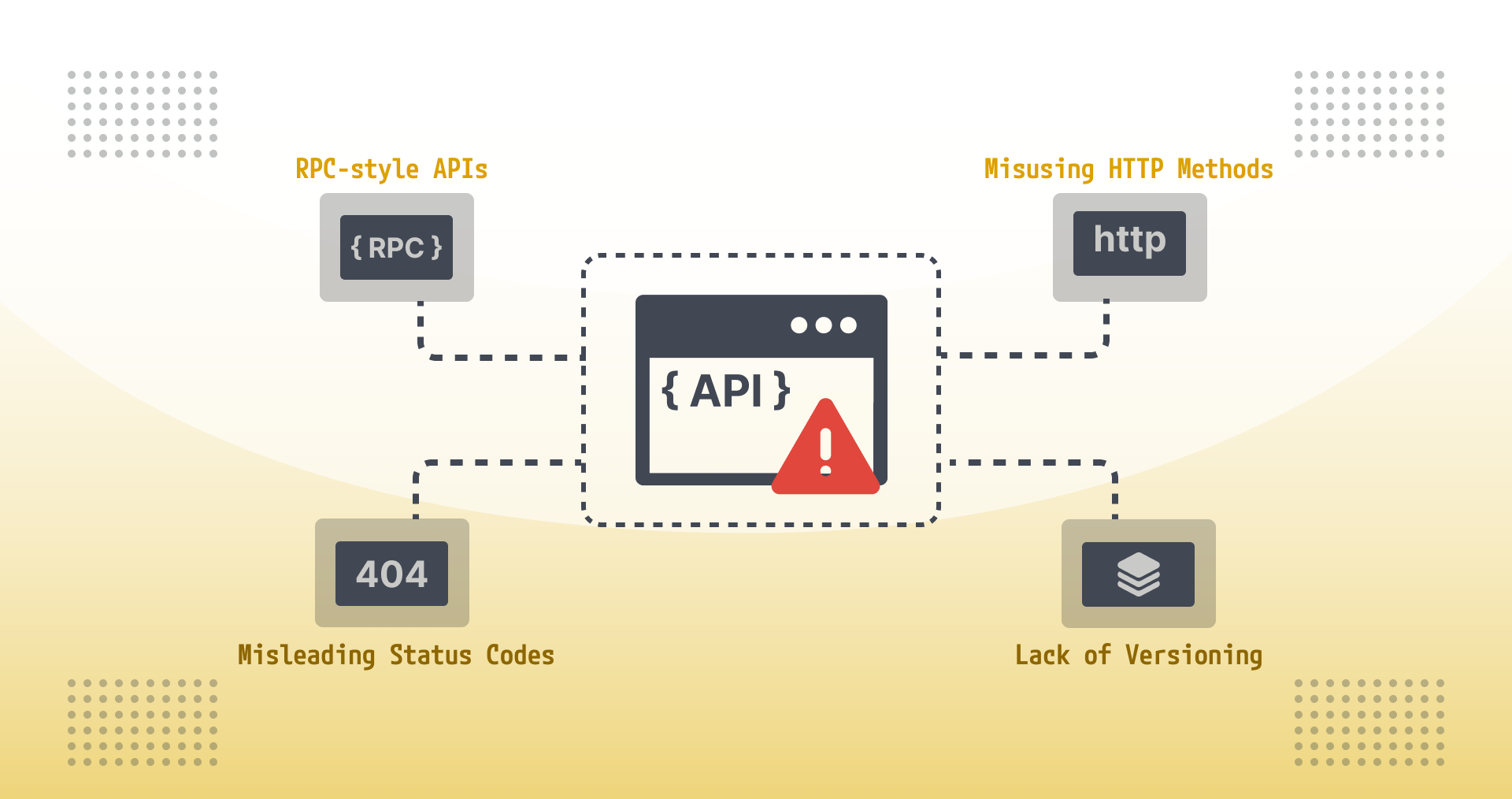
Remote procedure call (RPC) style APIs are a common anti-pattern in RESTful API design. These APIs expose methods that map directly to the underlying implementation, rather than focusing on resources. This makes the API rigid and difficult to evolve.
This occurs when developers try to anticipate every possible use case and build a complex API to accommodate them. Over-engineering leads to bloated and difficult-to-use APIs, making maintenance a nightmare.
Tightly coupling the client and server can make the API inflexible and difficult to change. This strong dependency between implementations makes the API brittle and hard to evolve without breaking clients.
Not versioning your API can lead to issues when you need to make breaking changes. Without clear versioning, managing updates and ensuring backward compatibility becomes a significant challenge.
Poorly documented APIs can be difficult to use and lead to confusion for developers. Good documentation provides clear descriptions of each method and the resources they return. It should help developers get started quickly rather than hunting through dense libraries of docs. Document your API well using tools like Xapi and Swagger.
HTTP methods like GET, POST, PUT, and DELETE are meant to convey the intended action of a request. Overloading these methods, or using them in ways that don’t match their intended purpose, can make the API confusing and difficult to understand.
Failing to handle errors properly can lead to a confusing and frustrating experience for developers using your API. Providing meaningful error messages and appropriate status codes is crucial for a good developer experience.
Your API is a collection of methods. Tunneling everything through a single HTTP method, like GET or POST, can make the API inefficient and difficult to manage.
Preventing caches from caching everything, and not supporting efficiency and revalidation, is a missed opportunity. Proper caching is crucial in RESTful APIs, enhancing performance and efficiency. Delegate cache header generation to infrastructure like Apache HTTPD. Clients should utilize caching to avoid redundant requests, using proxies like Squid. Web caches reduce latency by serving responses faster and lower network traffic by reusing data, saving bandwidth and costs.
Misusing or failing to use proper status codes when sending responses can lead to poor communication between the client and server. While many are familiar with 200, 404, and 500, there are many more codes that, if used correctly, provide richer communication.
Using cookies to propagate a key to some server-side session state violates REST principles and can lead to security issues. It's essential to manage states appropriately without misusing cookies.
Exposing your database schema directly through the API makes it inflexible and difficult to evolve. An API should abstract the underlying data model to provide a stable interface for clients.
The absence of links in representation means the API is not fully RESTful. Hypermedia links are essential for guiding clients through the available actions.
Ignoring MIME types reduces the flexibility and self-descriptiveness of the API. Proper use of MIME types is crucial for clear communication about the data formats used.
A single class or object handles too many responsibilities, violating the Single Responsibility Principle (SRP).
Unstructured and tangled code with poor separation of concerns.
Using hardcoded values without meaningful names.
Reversing the normal order in conditional statements.
Interfaces that are needlessly crowded and complex.
Overuse of singleton pattern across many classes.
Using primitive data types excessively instead of creating meaningful classes.
Reusing code by copying and pasting rather than abstracting and reusing properly.
Using code or patterns without understanding how they work.
Over-reliance on a single tool or pattern, applying it to all problems.
Keeping obsolete or unused code in the codebase.
Code that doesn't do anything or its purpose is unclear.
Adding unnecessary layers of abstraction or objects that serve no real purpose.
By being aware of these anti-patterns and actively working to avoid them, you can design APIs that are robust, maintainable, and easy for developers to use. This will lead to more efficient development processes and more successful software projects.
Share Article

API Design
In today's rapidly evolving digital landscape, organizations are constantly striving to accelerate development, enhance their offerings, and maintain a competitive edge. A critical, yet often overlooked, aspect of achieving these goals lies in the ability to truly see and understand digital assets.

Prabath Ariyarathna
13 February 2026
Read More
API Design
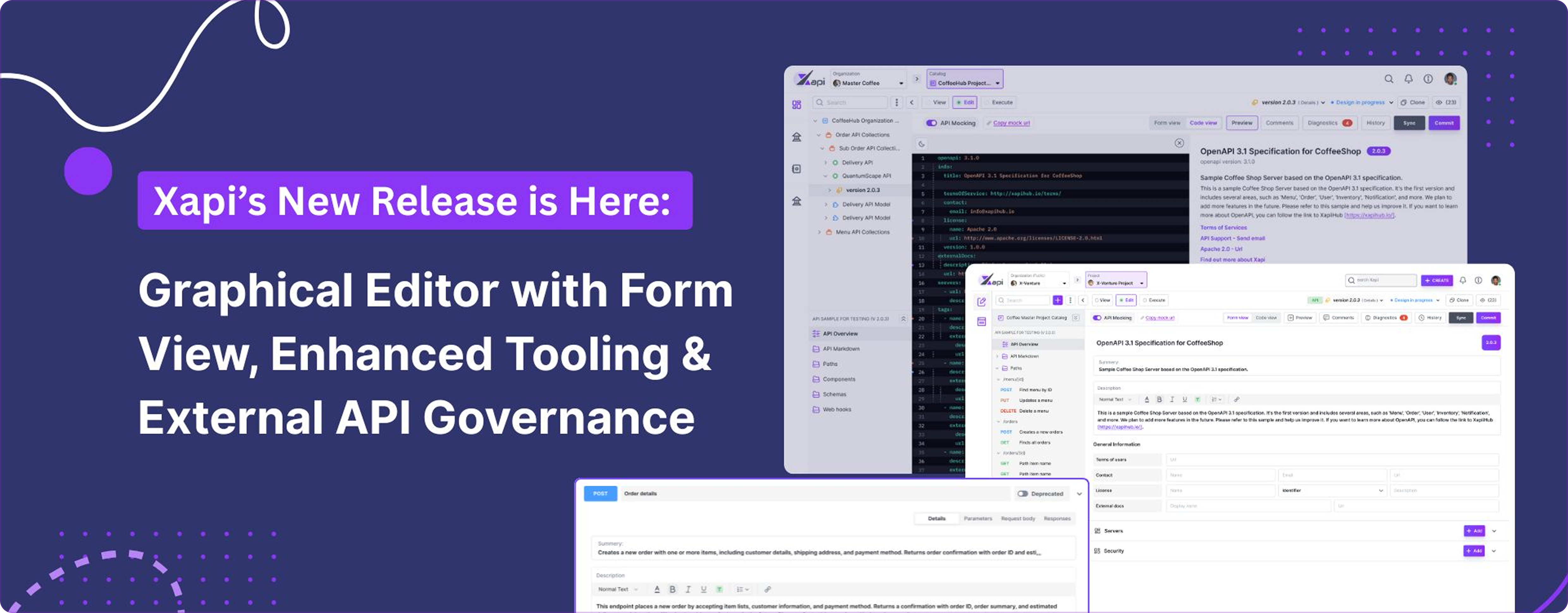
We're thrilled to unveil our latest Xapi platform update, bringing a more intuitive API design experience, tooling enhancements, and a smarter way to govern externally designed APIs. These new capabilities make API design and governance more accessible, more powerful, and more flexible than ever before.

Shamali Sathindra
8 April 2025
Read More

API Design
Every organization wants well-designed APIs, but the key is turning business needs into carefully crafted APIs that perfectly match their main business objectives.
Prabath Ariyarathna
17 February 2025
Read More


